What's the Difference Between a Coach, Teacher, and Mentor?

People use these words interchangeably all the time. "My mentor coached me through it." "My teacher was a great mentor." "I need a coach to teach me how to X better."
It's confusing because the lines blur in real life. A good teacher might mentor you. A mentor might coach you through something. A coach might teach you a framework.
But there are differences, and knowing them helps you figure out what you actually need.
Teacher: "Here's How to Do It"
What they do: Transfer knowledge or skills. They know something you don't, and they're going to teach it to you.
The relationship: Expert to learner. They have the information. You're there to absorb it.
What it looks like:
- Classes, courses, workshops
- Structured curriculum
- Demonstrations and explanations
- Assignments or practice exercises
- Assessments (tests, feedback on your work)
When you need a teacher: You don't know how to do something, and you need someone to show you.
Could be anything: A language. A software program. A physical skill. A creative practice. A technical method. A framework or system.
What makes a good teacher: They turn complex concepts into understandable ones. They show you the right way to do something. They can meet you where you are and adjust their explanations based on what you're struggling with. They give you ways to practice and improve.
What a teacher is not responsible for: Your motivation. Your application. Your commitment.
A teacher's job ends when they've taught you the thing. What you do with it after is up to you.
Mentor: "Here's What I've Learned"
What they do: Share wisdom, experience, and guidance based on having walked a similar path. They've been where you are (or somewhere close), and they're helping you navigate it.
The relationship: Experienced guide to someone earlier in the journey. It's relational, often long-term, and usually informal.
What it looks like:
- Sharing their own experiences and mistakes
- Offering advice based on what worked (or didn't) for them
- Making introductions or opening doors
- Providing perspective when you're stuck
- Being a sounding board
- Sometimes advocating for you or sponsoring you in professional contexts
When you need a mentor: You're navigating something where wisdom and experience matter more than a specific skillset. You need someone who's been there and can help you see around corners.
Examples:
- Early in your career and trying to figure out how to advance
- Starting a business and need someone who's built one
- Entering a new field or industry
- Making a major life transition, and like the perspective of someone who's been there
What makes a good mentor: They've done the thing you're trying to do (or something close enough to be relevant). They're generous with their time and knowledge. They're honest—they'll tell you the unedited version and the pros and cons, and when they think you're heading in the wrong direction. They care about your growth because generally, it reflects well on them.
What a mentor is not responsible for: Doing the work for you. Removing obstacles for you. Managing your emotions. Being available 24/7.
Good mentors have boundaries. They'll invest in you, but they expect you to show up and do your part.
Coach: "What Do You Think?"
What they do: Help you figure out the right answer for you. They don't tell you what to do—they ask questions that make you think differently, challenge your assumptions, and get clear on what you actually want and what's in your way. They are thought partners who guide you through taking action and holding you accountable.
The relationship: Collaborative partnership. You're both working on your agenda, but you're equals in the process. They're not the expert on your life—you are.
What it looks like:
- Asking reflective questions
- Creating structures or exercises to help you gain clarity
- Providing a different perspective to broaden your thinking
- Challenging inconsistencies or blind spots
- Holding you accountable to what you said you'd do
- Sometimes teaching a tool or framework, but only in service of your goal
When you need a coach: When you are dealing with a problem that has no objective right or wrong answer (Should you move to that city? Take that job? End that relationship?). Or you're not sure what you want, and you need help figuring it out. Or you know what you want to work on, but you're stuck.
The right answers are in you—and you want help accessing them.
This is when no one can give you a formula because what you're solving aren't math problems: "Do this and you'll find your perfect partner."
This is when a mentor's experience could be the opposite for you: "Taking that job was the best decision I made."
A coach helps you figure out what's right for you, not what's universally "correct."
Examples:
- You're avoiding a decision and don't know why
- You keep saying you'll do something but don't
- You're unclear on your priorities or what's important to you
- You're in your own head and need someone to help you think out loud
- You need accountability
- You keep finding yourself circling the same patterns, but can't see them or break them
What makes a good coach: They listen more than they talk. They ask questions you didn't think to ask yourself. They're comfortable with silence and uncertainty. They don't need to be the smartest person in the room—they're focused on making you smarter about yourself.
What a coach is not responsible for: Having the answers. Telling you what to do. Fixing your problems.
If you want someone to do it for you (build me a website, give me a 90-day plan), hire a consultant. If you want someone to help you solve it yourself, hire a coach.
A note on therapy: If what's blocking you is PTSD, clinical anxiety and depression, personality disorder, or other mental health issues, you might need a therapist, not a coach. Therapy addresses psychological healing and clinical conditions. Coaching assumes you're generally functional and helps you move forward from where you are (more on the difference here in this article).
The Reality: Most Good Coaches Are Hybrids
Here's what actually happens with coaches in the wild: many of them blend all three roles, and that's often what makes them effective.
Coaches who are also mentors:
If your coach has lived through what you're dealing with, they'll probably share that experience—and that's mentorship.
A coach who's recovered from burnout can say, "Here's what I noticed when I was in it. Here's what helped me." A coach who's navigated grief can share their journey. A leadership coach who spent 20 years leading teams has insights that pure coaching training can't replicate.
This is especially common (and valuable) in niche coaching. Career transition coaches who've transitioned careers. Entrepreneur coaches who've built businesses. Recovery coaches who've been in recovery.
The line between "I'm asking you questions to help you find your answer" and "I'm sharing what I learned so you don't make my mistakes" gets thin—but a well trained coach will always share their experience as one perspective to consider, not the perspective to adopt, and will check in with you on what's true for you so you can make the decision that's right for you.
Coaches who are also teachers:
Good coaches often teach frameworks, tools, and models.
They might teach you a decision-making framework, a model for understanding stress and burnout, a tool for managing anxiety, or a perspective on how habits form. They're not running a course on it—they're offering it as a resource in service of your coaching goals.
The difference: a teacher's primary job is knowledge transfer. A coach teaches you something because it's relevant to what you're working on right now, not because it's part of a curriculum.
When hybrid is good:
When the coach is clear about which hat they're wearing. "I'm going to share what worked for me here—take what's useful, ignore the rest." Or: "Let me teach you this framework, and then we'll use it to look at your situation and see what applies."
The mentoring and teaching support the coaching. They don't replace it.
When hybrid is a problem:
When the coach can't stop giving advice. When every session turns into "here's what you should do" instead of asking you questions that lead you to your understanding of what you want to do.
When they're teaching you their entire methodology instead of adapting to what you need.
When their experience becomes the lens for everything, and they can't see that your situation is different from theirs.
The test:
After a session, ask yourself: Did I come away with my own insights, or just theirs? Did they help me think, or did they think for me?
If it's the latter, you've got a mentor or teacher who calls themselves a coach. Which might be fine. Just know what you're getting.
Where It Gets Blurry (And Why That's Okay)
In practice, the best teacher-student relationships include some mentorship. The best mentors ask coaching questions. The best coaches sometimes teach you a framework.
But the primary function is different.
Example 1: Career transition
- A teacher would teach you the skills you need for the new role (how to code, how to use a design tool, how to do financial modeling).
- A mentor would share their experience transitioning careers, introduce you to people in the industry, and warn you about common pitfalls.
- A coach would help you get clear on why you're transitioning, what you're afraid of, what's holding you back from applying, and how to navigate the emotional/psychological side of the change.
You might need all three. At different times. Or from the same person playing different roles.
Example 2: Feeling Less Stressed at Work or in Life
- A teacher would teach you specific stress-management techniques: how to do box breathing, progressive muscle relaxation, or cognitive reframing. They'd explain how the technique works and give you steps to practice it.
- A mentor (someone who's navigated high-stress environments or learned to manage their stress) would share what worked for them: "I used to think I had to respond to every request immediately—that was killing me. Here's how I set boundaries. Here are the different ways of saying no." They'd tell you what they wish they'd known earlier.
- A coach would help you figure out why you keep saying yes to things you're not interested in? What's preventing you from setting the boundaries you want to? What does "less stressed" even mean to you and enable you to do? They'd help you see your own patterns and decide what to change.
Again: you might need all three.
How to Know What You Need
Ask yourself:
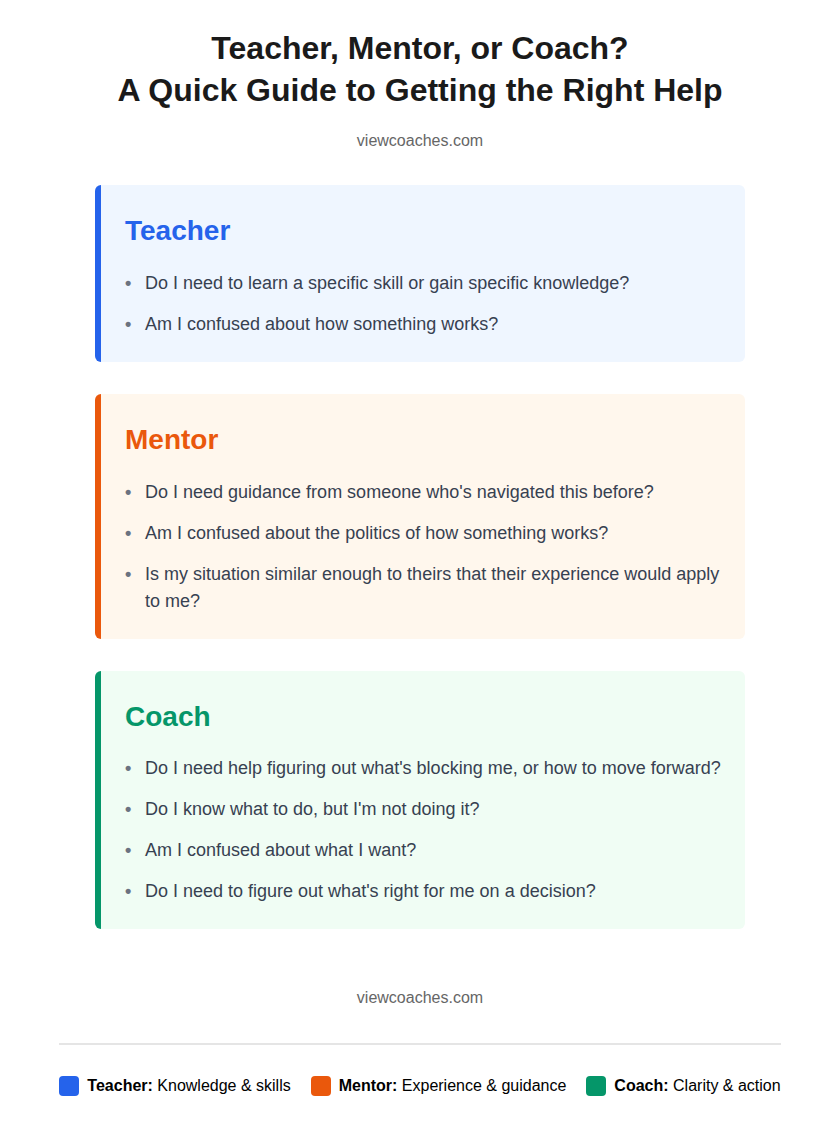
Do I need to learn a specific skill or gain specific knowledge? Teacher
Am I confused about how something works? Teacher
Do I need guidance from someone who's navigated this before? Mentor
Am I confused about the politics of how something works? Mentor
Is my situation similar enough to theirs that their experience would apply to me? Mentor
Do I need help figuring out what's blocking me, or how to move forward? Coach
Do I know what to do, but I'm not doing it? Coach
Am I confused about what I want? Coach
Do I need to figure out what's right for me? Coach
What Happens When You Pick Wrong
You hire a teacher when you need a coach: You learn a bunch of stuff but don't apply it. Or you learn the "right" way to do something but it doesn't fit your actual situation. You have knowledge without integration into your life.
You hire a coach when you need a teacher: You spend a lot of time talking about what you want to do, but you still don't know how to do it. You have clarity without skills.
You hire a mentor when you need a coach: You get a lot of advice, but it's their path, not yours. You might follow it and end up somewhere you didn't want to be. Or you feel like you should want what they wanted, and now you're more confused.
You hire a coach when you need a mentor: You figure out what you want but have no roadmap. You're clear but clueless about the practical realities. You reinvent wheels that someone with experience could've told you about.
None of these are disasters. You can course-correct. But it helps to know what you're looking for.
One More Thing: Sometimes You're Your Own Best Teacher, Mentor, and Coach
Not everything requires outside help.
You can teach yourself things (books, videos, practice). You can reflect on your own experience and extract lessons (journaling, thinking, learning from mistakes). You can ask yourself hard questions and sit with the discomfort until you find your answers.
But sometimes you can't. And that's when you bring someone else in.
The trick is knowing which role you need them to play—and making sure they're actually capable of playing it.
Looking for a coach (not a teacher or mentor, but an actual coach)? Use our directory to filter by approach, expertise, and style—so you can find someone who's good at asking questions, not just giving answers.