Certified vs Uncertified Coach: When Does Certification Actually Matter?

Let's get the uncomfortable part out of the way first: coaching certification is not legally required. It doesn't guarantee someone is good at coaching. And lack of certification doesn't mean someone's a fraud.
This rubs people the wrong way on both sides. Certified coaches feel like their training is being dismissed. Uncertified coaches with real expertise feel like they're being written off. And clients are stuck in the middle, trying to figure out what actually matters.
So let's talk about it openly.
What Certification Actually Tells You
When someone has a certification from a recognized credentialing organization (ICF, EMCC, etc.), here's what you know:
- They completed a training program
- They logged a certain number of coaching hours
- They were evaluated on their coaching skills
- They've committed to ongoing education and ethics standards
Here's what you don't know:
- Whether they're good at coaching you
- Whether their approach fits your needs
- Whether they have relevant life or domain experience
- Whether they've actually helped people with your specific situation
Certification is a data-point. It's not a guarantee.
When Certification Really Matters
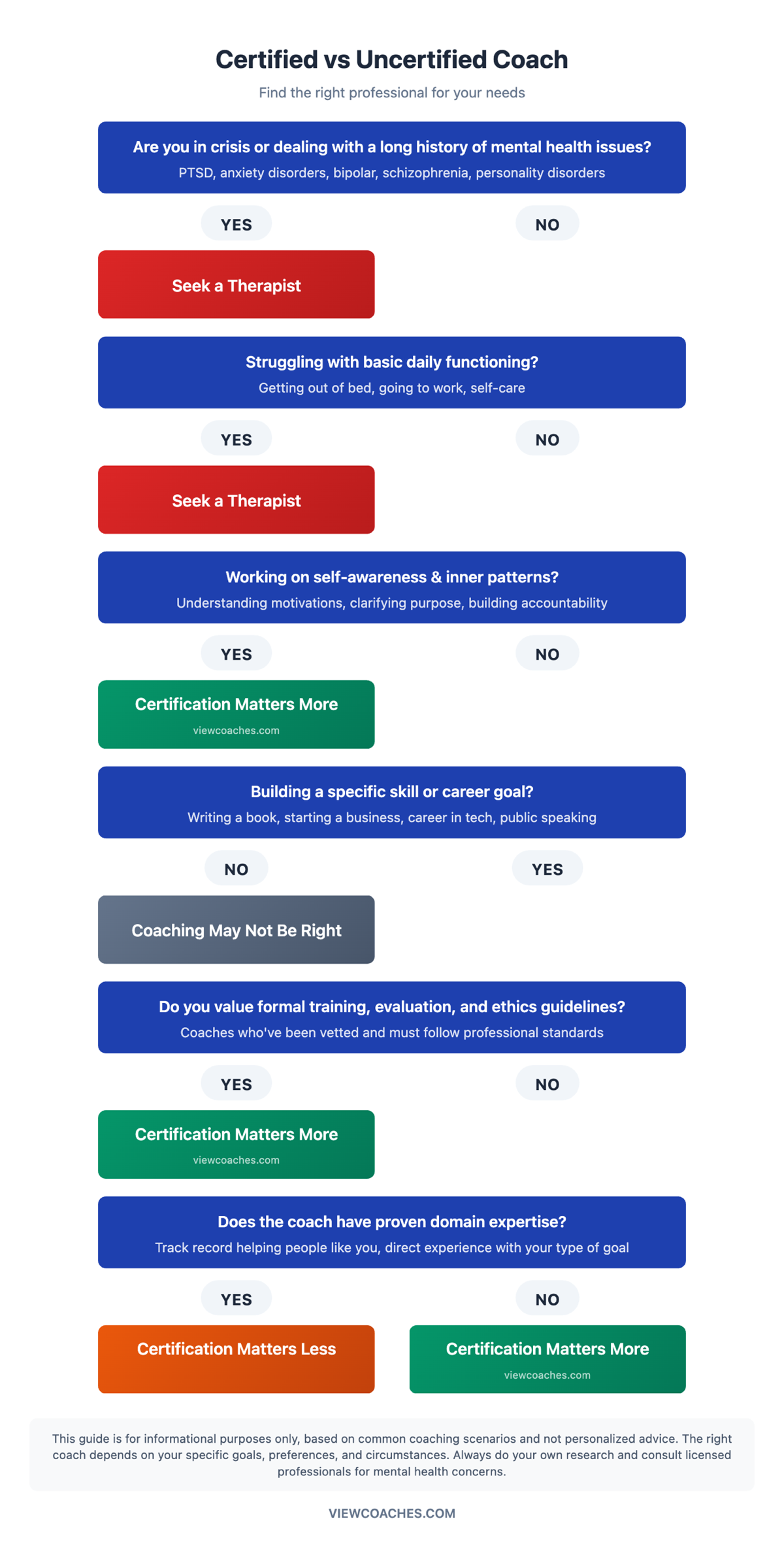
You value the vetting process. Certification programs include supervision, practice hours, and evaluation. If knowing someone's been vetted by an external organization gives you confidence, go with certified.
You care about ethics. Certified coaches are bound by their governing body's code of ethics and can be reported for violations. If a coach crosses a boundary, acts inappropriately, or harms you, there's a formal accountability structure. Uncertified coaches answer to no one.
You want pure coaching—not mentoring or teaching. If you're seeking coaching to increase self-awareness, understand your patterns and motivations, clarify what you actually want, or create accountability for meaningful goals—you want someone trained in the core coaching skills: deep listening, powerful questioning, and drawing out your own insights. This is where formal coaching training and certification from credentialing bodies like the ICF and EMCC (European Mentoring & Coaching Council) matters most.
The International Coaching Federation (ICF), the world's largest coaching organization and most widely recognized credentialing body, defines good coaching as maintaining "a mindset that is open, curious, flexible and client-centered"—meaning they're genuinely interested in you, not coming in with their own agenda. Good coaches also help you "translate insights into action steps," supporting accountability so you get tangible results, not just feel-good conversations.
(If you're emotionally fragile, in crisis, or dealing with clinical mental health issues—you need a therapist, not a coach.)
You want methodology and structure. Certification means they've been trained in a coaching methodology. If you're someone who wants a clear process, defined tools, and a structured approach, certification increases the likelihood they can offer that.
You're risk-averse. There's less variance with certified coaches. You're less likely to get someone truly terrible. You're also less likely to get someone wildly outside the box who might be exactly what you need. It's a safer bet, not necessarily a better one.
When Certification Might Matter Less
The coach has deep domain expertise that's more relevant than coaching training. A former startup founder coaching entrepreneurs on scaling their business. An ex-athlete coaching people on performance. A corporate executive coaching leaders in their industry. A published author coaching people through writing a book.
These people might know more about what you're actually facing than a certified coach who's never done the thing you're trying to do. Their coaching often blends mentoring (sharing experience) and teaching (offering frameworks) with coaching questions—and that hybrid approach might be exactly what you need.
They have a strong track record you can verify. References, testimonials, case studies, evidence that they've helped people like you with problems like yours. That's worth more than a certificate.
Their approach is transparent and makes sense to you. If they can clearly explain what they do, how they do it, why it works, and you can evaluate whether that fits your needs—that's more useful than knowing they passed a certification process.
You're working on concrete, domain-specific goals. If you're working on a career transition, starting a business, writing a book, or improving a specific skill—the risk is lower. Domain expertise and track record matter more than formal coaching credentials. You want someone who's been there, not just someone trained in coaching theory.
(Read more about the difference between coaches, mentors, and teachers here.)
The Real Risk Isn't Uncertified—It's Unqualified
Here's what makes someone unqualified, regardless of certification status:
Can't actually coach They give advice instead of helping you figure out what's right for you. They don't ask the kind of questions that shift your thinking or really listen to your answers. They assume their path is your path instead of helping you find yours—and that's the whole point of coaching: the insights you arrive at yourself are the ones that actually fit your life.
No clear methodology They can't explain their approach beyond vague talk about "intuition," "alignment," "transformation," or "trusting the process." If a coach can't talk plainly about their process beware they might be hiding behind jargons.
No track record No experience, references, substance.
Overpromising They guarantee outcomes they can't control instead of acknowledging that coaching creates clarity, motivation, and accountability—not certainty.
No self-awareness about limits They claim they can help with anything and don't know when to refer you elsewhere.
Credential misrepresentation Presenting weekend workshops as comprehensive training. Using titles like "Master Coach" without holding the ICF MCC credential. Claiming ICF or EMCC certification that doesn't show up when you search their member directories.
Disorganized Unclear pricing, missed sessions, chaotic scheduling, no basic business structure.
Stories That Illustrate the Point
Mike hired a triple-certified leadership coach. Great credentials. Trained in three different modalities. Nice website.
The coach kept canceling sessions, asked repetitive questions Mike had already answered, and rigidly followed a process instead of adapting to Mike's actual needs. Certification didn't guarantee a good experience.
Sarah hired an uncertified former tech executive. 20 years of leadership experience and a knack for asking the right questions.
Three months in, Sarah had restructured her team, delegated better, and stopped working 70-hour weeks. The coach knew the territory because she'd lived it.
Jennifer hired a certified coach specializing in burnout who was the perfect fit. Her coach had a structured approach but stayed flexible when Jennifer's experience didn't match the model. She challenged the mindsets keeping Jennifer stuck in burnout patterns while keeping action steps small enough to avoid overwhelm. Competence and fit.
Tom hired an uncertified "life coach" who was basically a motivational speaker. No actual coaching—no deep questions, no methodology, no helping Tom find his own answers. Just energy and charisma, generic advice, and Instagram quotes. Complete waste of money.
So What Should You Actually Look For?
Forget certified vs. uncertified for a second. Here's what matters:
Can they actually coach you? Are they a good listener? Do they ask questions that change the way you think? Do they work with a style and approach that makes you feel safe to open up and share personal parts of your life with them? Are they in service of your goals, or are they more interested in being right or looking smart?
Do they have a clear approach? Can they explain what they do and why? Or is it vague "transformation" talk?
Have they helped people like you? Not just in general—specifically people with your type of goal or challenge.
Do they have boundaries and ethics? Are they realistic about outcomes that are within their control? Will they refer you out if you need something they can't provide? Do they acknowledge their limits? Red flag: "I can help with anything." Green flag: "Here's what we can accomplish through coaching. Here's beyond the scope."
Can you verify their track record? Look at testimonials that are specific, not generic.
Do they make sense to you? When you talk to them, does their approach resonate? Do you feel like they get what you're dealing with? Does their pricing work for you?
Learn more about questions to ask before hiring a coach here.
The Certification Question to Ask
If you care about certification, don't just ask "are you certified?" Ask:
- Where did you train?
- Where did you get your coaching training and certification?
- How many hours of coaching have you logged?
- What type of continuing education do you do?
- What's your supervision or peer support structure?
If they're uncertified, ask:
- What's your background or expertise in this area?
- How did you learn to coach?
- What's your methodology?
- How do you stay sharp and keep learning?
- How is your "coaching" different from that of a teacher or a mentor?
Both can give you good answers and fluff. Listen for substance.
The Honest Truth
There are fantastic coaches who are both certified and uncertified.
Certification is useful information, not a guarantee. It raises the floor—you're less likely to get someone completely unqualified—but it doesn't ensure competence or fit. It's worth considering, but not the only determining factor.
The question isn't "do they have a certificate?" The question is "are they good at helping people like me with challenges like mine?"
Sometimes that person has letters after their name. Sometimes they don't.
Your job is to figure out which one is sitting across from you.
Also read: Coach vs. Teacher vs. Mentor